Building Performance
Daylight Modelling
Daylight Factor and sDA modelling · Green Star IEQ credits · IES VE and RadianceIES
Daylight access is a critical factor in building quality, occupant health, and planning outcomes. Ark Resources provides daylight modelling for residential apartments, commercial offices, and mixed-use developments across Victoria, New South Wales, and nationally. Our assessments use Daylight Factor (DF) and Spatial Daylight Autonomy (sDA) simulation to support planning permit applications, satisfy Green Star IEQ credit requirements, and guide design decisions from the earliest stages.
Using IES VE and RadianceIES simulation platforms, we calculate daylight factor and sDA metrics for residential, commercial, and mixed-use projects. Our reports identify underperforming spaces early and provide practical design recommendations including glazing optimisation, reflectance strategies, and layout adjustments that improve daylight outcomes without compromising thermal performance.
With experience across high-density residential towers, commercial fitouts, and mixed-use precincts, our team understands the interplay between daylight performance, thermal performance, and energy efficiency. We work directly with architects and designers to embed daylight performance into the design process from the earliest stages.
Daylight Factor (DF)
A steady-state ratio comparing internal illuminance to outdoor illuminance under a standardised CIE overcast sky of 10,000 lux. Sun position, orientation, and climate have no effect. DF measures how well diffuse light penetrates a space under uniform overcast conditions and is used as a minimum threshold check in ESD reports and planning submissions.
Spatial Daylight Autonomy (sDA)
A climate-based dynamic metric that models real sun angles, local weather patterns, and seasonal variation specific to your project location. sDA measures what percentage of occupied floor area receives at least 160 lux for at least 80% of annual occupied hours - reflecting actual daylight conditions rather than a theoretical uniform sky. Required for Green Star IEQ credits.
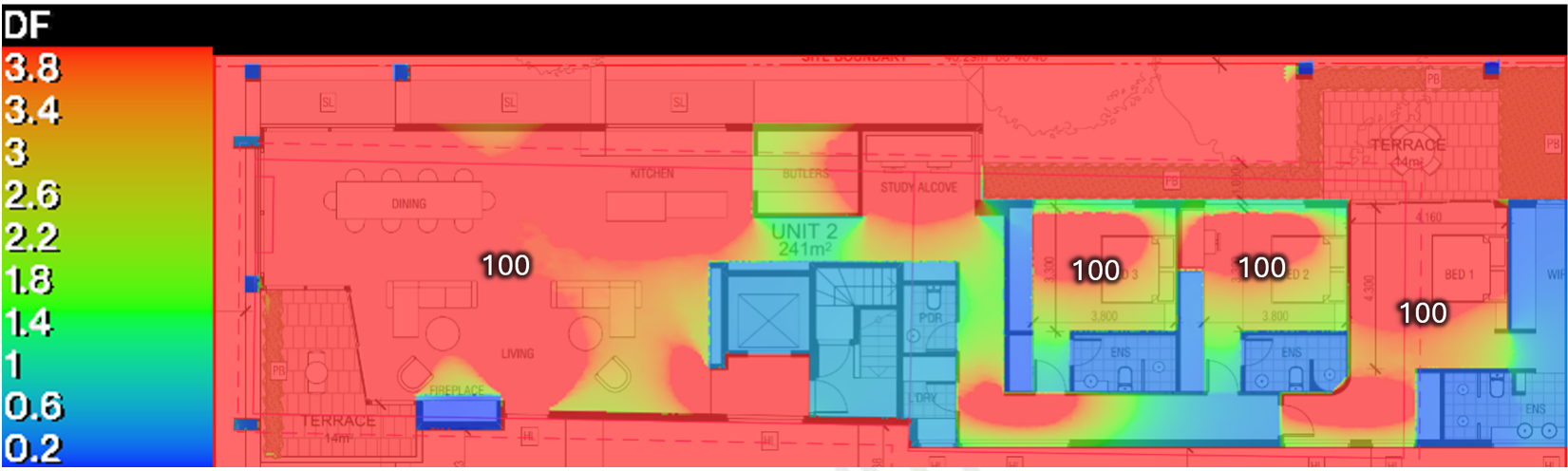
Example Daylight Factor (DF) output from RadianceIES simulation. Colour scale from low (blue) to high (red) DF values across a residential apartment floor plate.
Daylight Modelling Services
Daylight Modelling vs Sunlight Analysis
Daylight modelling and sunlight analysis are often confused but measure fundamentally different things. Ark Resources provides both - knowing which you need depends on your project's compliance requirements.
Daylight Modelling
- →Metrics: Daylight Factor (DF) and Spatial Daylight Autonomy (sDA)
- →Measures natural light quality and availability throughout a space
- →sDA models all sky conditions - overcast, partly cloudy, and direct sun
- →Common use: Green Star IEQ credits, ESD planning reports
Sunlight Analysis
- →Metric: Direct sunlight hours received by habitable rooms and open space
- →Measures hours of direct sun using actual sun position on a given date
- →Assessed for a specific period - e.g. winter solstice, 9am to 3pm
- →Common use: Housing SEPP compliance, NSW apartment submissions
Daylight Modelling FAQs
What is the difference between Daylight Factor (DF), sDA, and Sunlight Analysis?
All three measure natural light but in fundamentally different ways, and each serves a different compliance purpose.
Daylight Factor (DF) uses a standardised uniform overcast sky (10,000 lux) to measure the ratio of indoor illuminance to outdoor illuminance. Sun position, orientation, and climate play no part. It is a static threshold check used in ESD reports and planning submissions.
Spatial Daylight Autonomy (sDA) is a climate-based dynamic metric that models all sky conditions throughout the year - overcast, partly cloudy, and clear sky with direct sun. sDA does not exclude direct sunlight; it incorporates all light sources based on real local weather and sun angle data for your location. It measures what percentage of occupied floor area receives sufficient light (160 lux for at least 80% of annual occupied hours).
Sunlight Analysis measures only direct beam sunlight from the sun disc. It calculates how many hours a habitable room or open space receives direct sun on a specific date (typically winter solstice, 9am to 3pm). Diffuse sky light is not counted. Sunlight Analysis is used for Housing SEPP compliance in NSW and is a separate service to daylight modelling.
What is the difference between Daylight Factor (DF) and Spatial Daylight Autonomy (sDA)?
DF is a steady-state metric that measures the proportion of indoor illuminance to outdoor illuminance under a standardised overcast sky of 10,000 lux. It does not account for sun position, orientation, or local climate. sDA is a climate-based dynamic metric that models actual sun angles and local weather data, measuring what percentage of occupied floor area receives at least 160 lux for at least 80% of annual occupied hours. DF is used as a minimum threshold check in ESD reports and planning submissions. sDA is required for Green Star IEQ credits and reflects real-world daylight conditions more accurately.
When is a daylight modelling report required?
A daylight modelling report is typically required when a project is pursuing Green Star certification with IEQ daylight credits, or when a council or planning authority requests evidence of daylight performance as part of an ESD planning report. It is also used proactively to assess and improve apartment layouts and glazing specifications before construction documentation is finalised.
What software does Ark Resources use for daylight modelling?
We use IES VE for climate-based Spatial Daylight Autonomy (sDA) modelling and RadianceIES for Daylight Factor assessments. Both are industry-standard platforms accepted by GBCA for Green Star submissions and by planning authorities for ESD compliance reports.
Can daylight modelling help improve my design?
Yes. Early engagement allows our team to identify underperforming spaces and recommend glazing sizes, reflectance values, orientation adjustments, and shading strategies that improve daylight outcomes before construction documentation is locked.
How does daylight modelling relate to thermal performance?
There is a direct trade-off between daylight performance and thermal performance. Increasing glazing area improves daylight but may increase heating and cooling loads and reduce NatHERS or Section J compliance. Ark Resources can model both simultaneously to find the optimal balance for each project.
How long does a daylight modelling report take?
A standard daylight modelling report takes 1 to 3 weeks depending on project complexity and the documentation available. Green Star sDA assessments may take 2 to 4 weeks. We provide accurate timelines at project briefing.
Our Daylight Modelling Team
Our consultants deliver Daylight Factor and sDA modelling for planning, Green Star certification, and design optimisation across Australia. Get in touch to discuss your project.



You May Also Need
Need a daylight modelling report?
Ark Resources delivers Daylight Factor and sDA modelling for ESD planning reports, Green Star certification, and design optimisation across Australia. Contact us to discuss your project.